

The transition to electric propulsion is accelerating in the maritime and inland waterway sectors. And the good news is: numerous funding schemes are now available to significantly reduce the cost of your project. CEE, PAMI, ADEME, European funds… this guide presents the main financing solutions to help you transition to electric power with confidence.
Why Go Electric? A Future-Proof Choice
Theelectrification of boats and engines is no longer reserved for pioneers. Silent, clean, economical to use, and increasingly efficient, electric propulsion is becoming the go-to solution for a sustainable navigation. Whether you are inland waterway professional, passenger boat operators, or nautical tourism stakeholder, the question is no longer really why go electric, but how to finance it.
Public authorities have clearly understood this: several national and European schemes have been put in place to support this transition. Here's a comprehensive overview.
CEE: The cornerstone of electric inland waterway financing
What are Energy Savings Certificates?
The Energy Savings Certificates (CEE) are the most accessible and tangible scheme for financing your transition to electric. It's a national mechanism where energy suppliers (EDF, TotalEnergies, Engie, etc.) are obligated to finance projects that reduce energy consumption. In plain terms: they pay for part of your investment.
In the inland waterway sector, two CEE fact sheets directly concern you.
CEE TRA-EQ-126 — Electric Repowering of an Existing Vessel
This fact sheet is for you if you wish to replace your thermal engine with an electric or hybrid propulsion system on a vessel already in service.
Eligible Vessels:
- Workboats
- Passenger vessels
- Hotel barges
- Sightseeing boats
- Certain pleasure boats
Conditions to meet:
- Installation must be carried out by a qualified professional
- A monitoring system must be added (hour meter or BMS — Battery Management System)
- The boat must be pre-existing
Not eligible: new boats, boats that are already electric or hybrid, and certain large cruise ships.
CEE TRA-EQ-127 — Purchase of a new electric or hybrid boat
Are you considering purchasing a new electric or hybrid propulsion boat ? This fact sheet allows you to benefit from purchase or long-term rental assistance.
Eligible boats:
- Workboats
- Passenger boats
- Barges
- Pleasure boats
- Recreational boating
Eligible propulsion types:
- 100% electric
- Series hybrid
- Parallel hybrid
Key points:
- The more your vessel is used, the higher the aid can be (EEC certificates reward actual energy savings)
- For leases, the minimum duration is 60 months
- The application must be submitted within 12 months of the project
Maritime EEC Certificates: An Upcoming Expansion
As of July 1, 2026, the scope of EEC certificates will extend to the maritime sector. These are not new schemes, but a welcome expansion that will allow more stakeholders to benefit from the EEC mechanism for their decarbonization projects.
Key Takeaways on EEC Certificates
EEC certificates offer several key benefits:
- Tangible investment support, paid upon validation of the application
- Combinable with other schemes (PAMI, regional aid, etc.)
- Suitable for both retrofitting and new builds
- Particularly accessible for inland waterway stakeholders
The PAMI: the ally of inland waterway professionals
The Aid Plan for Modernization and Innovation (PAMI) is a scheme by Voies Navigables de France (VNF)designed to help professionals in inland waterway transport and tourism modernize their fleet.
Who is eligible?
- Inland waterway operators
- Shipowners
- Freight carriers
- Passenger vessels
- Rental pleasure craft
- Certain shipyards and engineering firms (innovation component)
The 4 components of the PAMI
A Improve the environmental performance of vessels
B Develop inland waterway logistics
C Support the industry's renewal
D Support innovative projects
For an electric repowering, retrofit, or energy optimization project, sections A and D are particularly relevant.
PAMI's Strengths
- Combinable with CEEs, certain ADEME grants, and regional aid
- A single simplified application to simplify administrative procedures
- Please note: the project must not have started before submitting the application (no signed quotes, no committed orders)
ADEME: a call for projects for maritime decarbonization
TheADEME is launching a call for projects dedicated to the decarbonization of maritime transport and services, with investment aid for:
- The acquisition of an electric propulsion system
- The purchase of a new, less polluting vessel
- The electric retrofit of an existing vessel
Application dates: from April 2, 2026 to July 6, 2026 (closing at 11:59 PM).
Who can apply? Private or public economic actors: vessel owners, shipowners, charterers, shipyards, equipment manufacturers, seaports, terminal operators…
Three themes are covered:
- Direct decarbonization of vessels (propulsion, batteries, retrofit)
- Industrial investments for decarbonization (production lines, manufacturing of electrical systems)
- Port investments (charging stations, shore power infrastructure)
⚠️ Please note: this call for projects does not apply to recreational vessels, fishing vessels, river boats, or non-EU flagged vessels.
The EMFAF: the European fund for maritime and fisheries stakeholders
The European Maritime, Fisheries and Aquaculture Fund (EMFAF) is a European Union funding program that helps maritime stakeholders modernize their equipment and accelerate their energy transition.
In France, these grants are managed by FranceAgriMer, the Regions, and certain government agencies.
It can finance electric repowering, hybridization, battery systems, and emission-reducing equipment. This scheme primarily targets professionals and businesses in the maritime sector (fishers, aquaculturists, maritime companies, fishing ports).
Bpifrance: the “Decarbonization of Fishing Vessels” call for projects
Bpifrance, in partnership with the maritime decarbonization fund created by CMA CGM, is launching a call for projects dedicated to the energy transition of professional fishing vessels.
The aid takes the form of a direct grant, with amounts generally ranging from 30 000 € and 500 000 €depending on the projects.
It can fund electric repowering, hybridization, feasibility studies, as well as innovative technologies and prototypes.
Regional aid: consider your region
Many regions offer their own support schemes for the nautical energy transition. These grants vary depending on your navigation area and your region of establishment. Don't hesitate to inquire with your regional council or local economic development agencies — they can often be combined with national schemes.
A European call for proposals to keep an eye on
If you are an innovative company in the field of electric marine propulsion, a call for proposals from the Horizon Europe program (scheduled for December 2026) might be of interest to you. To learn more, consult the official source directly on the European Commission portal: ec.europa.eu — HORIZON-CL5-2027-03-D5-17.
In summary: combine grants to maximize your funding
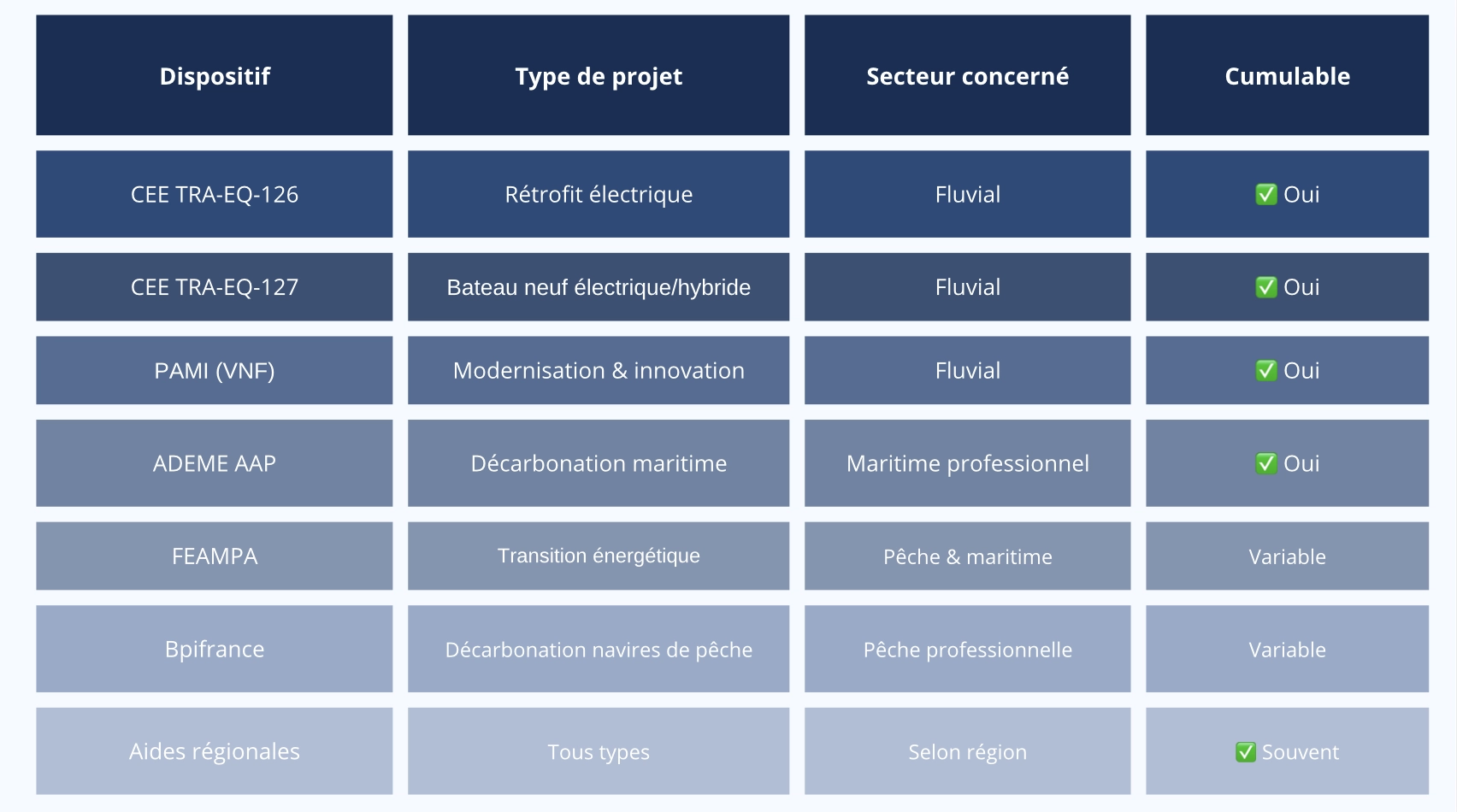
The good news is that These schemes are often cumulative. A single electric repowering project can thus benefit from CEE, PAMI, and regional aid simultaneously.
Weenav is here to help
At Weenav, we design and distribute electric propulsion solutions for workboats, tourist boats, and recreational vessels. We understand the industry's challenges, and we're here to help you find the technical and financial solution best suited to your project.
Do you have an electric or hybrid propulsion project?
Contact us our teams can guide you towards the schemes most suitable for your situation.
Published on: 02/06/2026
Author: Sophie Castelain

