
Electric boat: real costs, maintenance and profitability in under 10 years
Are you hesitating to make the switch to electric? Discover the concrete figures that will transform your view of maritime investment.
The Transition to Electric Propulsion Is no longer just an ecological trend — it is a strategic economic decision. With fuel prices rising, environmental regulations becoming increasingly strict and maintenance costs soaring, shipowners, fleet operators and private boat owners are all seeking clear answers to one essential question: how much does an electric boat really cost over 10 years?
At Weenav, we support the electrification of boating with our KRONOS and ARION propulsion systems. The data is clear: profitability is no longer a question of “if”, but of “when.” Here is everything you need to know before making your decision.
Weenav solutions: KRONOS and ARION, two ranges for all your needs
KRONOS: The 100% electric outboard motor from 80 to 300 hp
The KRONOS represents the future of outboard propulsion. Designed and assembled in France, this electric motor offers impressive performances for all types of boats.
KRONOS technical characteristics:
- Available power: from 80 to 300 horsepower
- Maximum torque from the start
- Operation from 400V to 800V
- Specific base: designed to absorb electrical power
- Fast charging: Compatibility: Combo CCS (up to 200 kW), charging up to 2C (from 10% to 90% in 30 minutes)
- Watertightness: IP67 marine certified
- Interface: control developed with Garmin for optimal management
KRONOS price (excluding batteries):
- 80 ch: €39,900
- 110 hp: €46,900
- 150 hp: 58,200€
- 200 hp: 67,900€
- 250 hp: 69,900€
- 300 hp: €79,900
KRONOS apps:
- Passenger transport and shuttles
- Professional boats (fishing, aquaculture, port services)
- Recreational activities (water skiing, wakeboarding, towed buoy)
- Tenders with the need for quick refills
- Fleets in sensitive areas (urban water bodies, reserves, lakes)
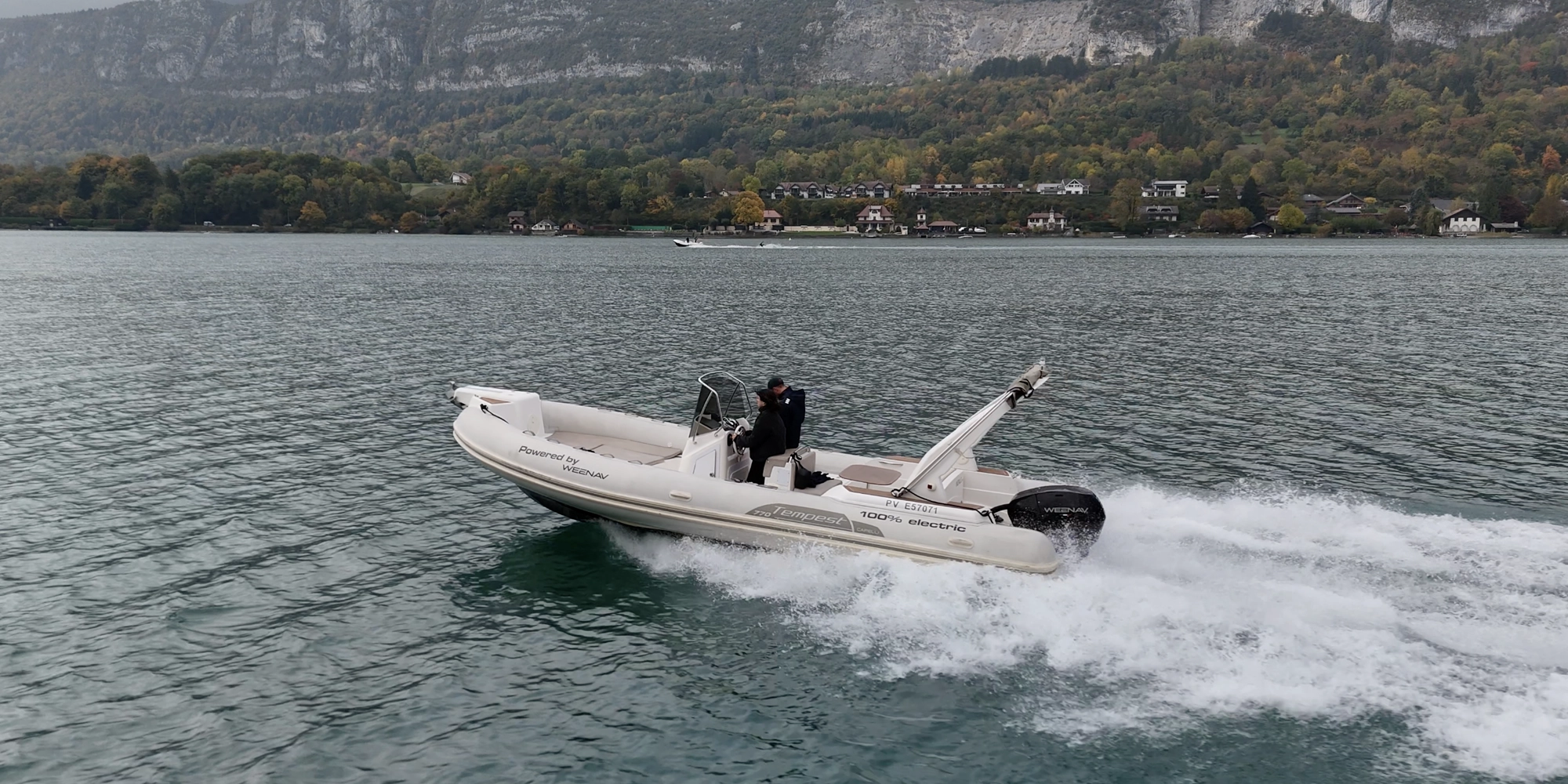
Concrete example: On a Capelli Tempest 770 equipped with a 200 hp KRONOS with 26 battery modules (140 kWh at 689V), you get a maximum speed of 35 knots
ARION: The powerful and discreet inboard engine from 100 to 1000 hp
The ARION Is our Inboard solution for medium and large boats, available in configuration 100% electric or hybrid (series/parallel).
ARION technical characteristics:
- Available power: from 100 to 500 hp in single mode, up to 1000 hp in double configuration
- Energy efficiency: Up to 97% efficiency
- Configuration: compact and lightweight engine to optimize space on board
- Lifespan: designed for over 30 years of sailing
- Maintenance: first significant maintenance after 10,000 hours of navigation
- Torque: superior to internal combustion engines for all sailing conditions
- Versions: 100% electric, serial hybrid or parallel hybrid
100% electric ARION price (excluding batteries):
- 100 ch: 30,417€
- 200 ch:45,750 €
- 500 ch:74,917 €
ARION apps:
- Passenger transport (speedboats, water buses, shuttles)
- Tour boats and sightseeing cruises
- Luxury boats and private yachts
- Freight transport and river logistics
- Service and professional boats
- Inland and maritime navigation
The hybrid option: If you want to keep a thermal component (diesel, hydrogen, biogas) according to your needs, the ARION can be coupled with your traditional engine. You thus reduce noise, vibration, odors and consumption while navigating in areas where thermal energy is restricted.
Detailed comparison: electrical vs thermal over 10 years
Energy costs: the overwhelming advantage of electricity
Diesel thermal boat:
- Average consumption: 10 * to 50 liters/hour depending on power and speed
*10 L/h corresponds to a low power boat
- Marine diesel price:
- Forecast 2025-2026:1.70 to 2.00 €/liter
Note: this is not a general rule for professionals, some offers may vary
- Hourly cost (8m boat, 150 HP at 10L/h): 17 to 20€
- For 300 hours/year: 5,100 to 6,000 €/year
- Over 10 years: 51,000 to 60,000€
Weenav KRONOS/ARION electric boat:
- Average consumption: 15 to 30 kWh/hour depending on power and speed
- Electricity price: 0.10 to 0.20 €/kWh (standard rate + fast charging)
- Hourly cost: 3 to 7.50€
- For 300 hours/year: 900 to 2,250 €/year
- Over 10 years: €9,000 to €22,500
Fuel economy over 10 years: 28,500 to 51,000€ for standard use!
For professional fleets with 1000h/year of use, the savings reach 95,000 to 170,000€ over 10 years.
Interview: The Silent Revolution
Thermal boat maintenance (average annual costs)
Mandatory preventive maintenance:
- Changing and changing engine oil: 200 to 400€
- Filter replacement (air, fuel, oil): 150 to 300€
- Cooling system check: €100 to €200
- Injection system and spark plug control: 100 to 200€
- Propeller shaft and seal maintenance: 150 to 300€
- Complete engine overhaul (every 5-7 years): 1,000 to 3,000€
- Average annual maintenance total: 800 to 1,500€
Common failures (unexpected):
- Water pump: €150 to €400
- Cooling system repair: €300 to €800
- Turbo or injector replacement: 500 to 1,500€
- Alternator/starter electrical problems: 200 to 600€
Total thermal maintenance cost over 10 years: €10,000 to €20,000
Weenav KRONOS & ARION electric motor maintenance
The revolutionary observation:
- No draining
- No oil filter changes
- No spark plugs
- No complex cooling systems
- No timing belts
Actual maintenance:
- Visual verification and cleaning of connections: 100 to 200 €/year
- Electronic system control (software update): minimal
- First ARION maintenance: after 10,000 hours (i.e. around €500,000 in fuel savings)
- First KRONOS interview: after 10,000 hours
- Average maintenance cost: around €500 every 20,000 hours for ARION
- Realistic total annual cost: €150 to €300
Over 10 years: €1,500 to €3,000
Maintenance savings over 10 years: 7,000 to 17,000€
Batteries: the strategic investment
The Lithium Iron Phosphate (LiFePO4) batteries equipping our systems offer exceptional performances.
Weenav battery characteristics:
Lifespan: 3,500 to 7,200 charge cycles: 6000 cycles (recharges, full discharges)
- Real life expectancy: 20 to 30 years with optimal management
- Depth of discharge: up to 80-100% without major degradation
- Protection: waterproof IP67
- Integrated BMS: automatic management for maximum longevity
- Self-discharge: very low compared to previous technologies
Probability of replacement within 10 years: very low with optimized use. With more than 6000 cycles, even with 150 cycles per year (intensive use), you exceed 23 years of life.
Our batteries are designed to last as long as your boat. With an efficient BMS and intelligent management, they represent a long-term investment.
The invisible but very real benefits
Beyond pure numbers, electrification with Weenav KRONOS and ARION engines brings benefits that are often underestimated in profitability calculations.
Image value and competitive advantage
For boating professionals, going electric also means:
- +15 to 25% commercial attractiveness with customers sensitive to environmental issues
- One strong differentiation in increasingly competitive markets
- Valuing communication: “zero emission fleet”, “silent navigation”, “concrete environmental commitment”
- A better positioning in the face of public and private tenders integrating CSR criteria
Access to restricted areas... and the expectation of future standards
The regulations are changing rapidly:
- Low Emission Zones (ZFEs) in rivers and ports
- Access restrictions for heat engines
- Limitation of noise pollution in tourist and natural areas
An electric boat Anticipate these developments, avoids additional compliance costs in the future and guarantees long-term business continuity.
Onboard comfort and user experience
Electric power is transforming the sailing experience:
- Total silence, no vibrations or odors
- Smoother and more pleasant navigation
- Better comfort for passengers, crews and residents
- Reduced fatigue for professionals with long operating days
Increased comfort is also better customer loyalty and more positive feedback.
Overall profitability over 10 years: the verdict is clear
By combining:
- Les energy savings (up to 170,000€ for a professional fleet)
- Maintenance savings (up to 17,000€)
- La exceptional longevity motors and batteries
- Les financial aid (EEC, PAMI, territorial arrangements)
- And the indirect commercial benefits
Electric propulsion is becoming not only profitable, but also strategically essential.
The question is no longer “is it profitable? ” But rather: how much longer can you afford to stay in the thermal?
Weenav, your partner in the electrical transition
Chez Weenav, we don't just sell engines. We support a complete transformation of your navigation model :
- Personalized technical and energy study
- Motor and battery sizing (KRONOS/ARION)
- Support for financial aid (EEC, PAMI, institutional partnerships)
- Long-term integration, monitoring and optimization
Do you have an electrical remotorization project?
Contact Weenav for a personalized study and find out how much your transition can really cost you... after grants and CEE.
Tomorrow's sailing is already here.
Quiet, efficient and profitable.

