
Skip to electric motor is not just about changing the energy source. It means adopting a new way of flying — more attentive, more proactive, and ultimately more engaged with the marine environment. For professionals as well as for boaters, theeco-piloting becomes a skill in its own right.
Electric vs thermal: a fundamentally different logic
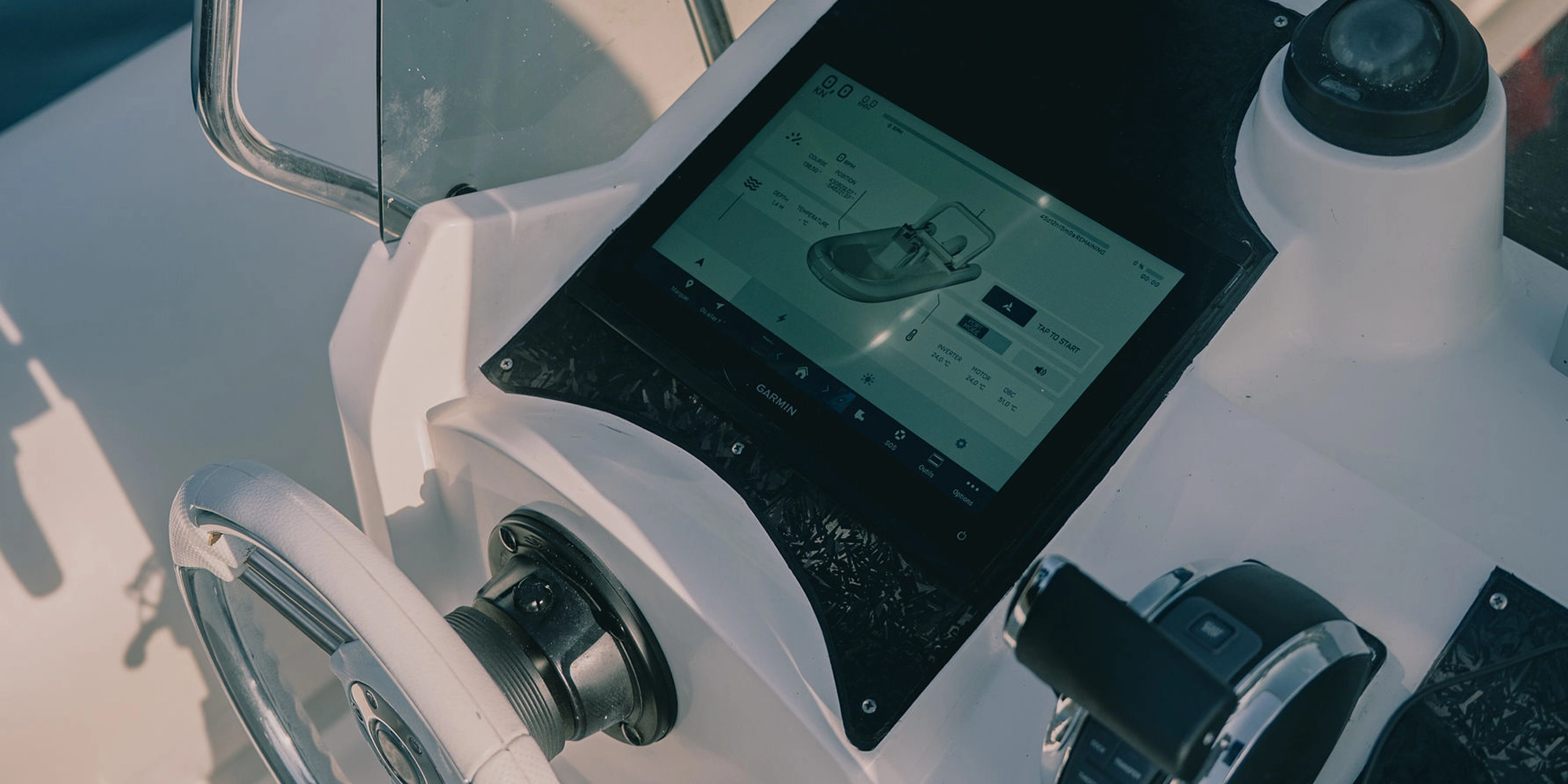
The electric motor imposes a new way of reading your navigation. Where thermal power drowned information in noise, vibration and a fuel flow that was difficult to feel in real time, the electric makes everything visible and immediate: the power required, the impact of acceleration, the effect of a modified heading. The dashboard doesn't lie.
This transparency reveals a physical reality that the thermal element masked: hydrodynamic resistance increases with the square of the speed, and the power required with the cube. In short — doubling your speed does not double your consumption, it multiplies it much more. The electric sailor sees it instantly in the state of charge of its batteries. It is a constraint, but above all it is information that thermal technology never gave him.
That's what makes an electric motor that educates as much as it propels — and that directly rewards good navigation choices.
What electric cars really change on board
One electric motor delivers its maximum torque from the start. It starts without vibration, without ramping up, without diesel smell. On board a professional shuttle or a day-boat, this smooth operation immediately transforms the experience — passengers, crew and environment all benefit from it.
But the electric one also brings a constraint that the thermal one does not know: the on-board energy is limited. It is this constraint that is the basis of eco-piloting—the art of navigating in a way that makes the most of it.
0 Local program for use
×2 Autonomy gained at optimal speed vs maximum
100% Of the couple from the first round
− 30% Conso with power outlet well exploited
Electrical engineering is not a constraint experienced, it is a mechanism that must be mastered. Operators and boaters who adopt adapted driving achieve autonomy performances that often surprise thermal skeptics.
Speed: the most powerful lever
Reduce your speed by 20%, it often means doubling your real autonomy.
The optimal cruising speed for an electric ship is generally between 60% and 75% of its maximum speed. Otherwise, time is lost without a proportional gain. Beyond that, consumption is getting out of control.
Pro For electric shuttle and ferry operators, this parameter must be integrated as soon as rotations are planned. A cruising speed that is too ambitious can compromise the return to the dock — or force you to cut back on the other consumers on board.
Piacenza Boaters who discover electric vehicles must learn to resist the urge to “push the gas”. An on-board screen displaying the power required in real time is a valuable ally here.
Anticipating: the discipline that makes the difference
The Electric motor rewards foresight. Smooth acceleration, early deceleration, reading environmental conditions — each of these actions directly translates into nautical miles gained.
Currents and tides
High current can reduce power consumption by 15 to 30%. Planning your routes according to tide times means sailing with the sea, not against it.
Gentle accelerations
In electricity, the couple is available immediately and in full — it is a strength, but also a temptation. To crush the gases in a heavy sea means working against the waves rather than with them: the hull sinks, consumption explodes, and the comfort on board falls. Progressive acceleration allows the boat to rise in the swell, to find its footing and to move forward with the environment rather than fighting it.
Anticipated deceleration
Sailing well in electric mode also means reading the sea in advance. Faced with a series of waves, the right reflex is not to force the passage — it's to dose the power to take each wave at the right angle, at the right time. Raise the gas early, let inertia carry the boat around, choose your course rather than suffer it: these actions are as much about marine common sense as they are about saving energy.
Pro On ships in regular service — buoysters, maritime business stars, shuttles — electricity reveals something that thermal energy was masking: the quality of control has a direct and measurable impact on consumption. Repeated rotations allow crews to refine their reading of conditions and to build real economical navigation profiles on known routes. Some embedded systems record and optimize these profiles — but it's primarily a driving culture that makes the difference.
Deceleration: a maneuver, not a loss
On a combustion engine, raising the gas has no direct energetic consequence — the fuel no longer flows, that's all. In electricity, deceleration becomes a navigation phase in its own right. The inertia of the boat continues to carry it, the power called falls to zero, and the sailor who anticipated his maneuver moves forward without consuming fuel.
It is a driving logic that good electric sailors quickly internalize: every meter traveled on the momentum is a meter that costs nothing. Approaching a dock, crossing a narrow channel, slowing down before a traffic zone — these moments are no longer braking, they are controlled navigation phases.
Pro On shuttles and ferries in intensive operation, this discipline of early deceleration, applied to each rotation, represents a real and cumulative energy saving. Some operators are now integrating it into the training of their crews as a performance criterion in its own right — in the same way as cruising speed or equipment management.
Charging: planning the way you plan a route
Charging is not an accessory constraint — it is an integral component of electric navigation. It is planned in the same way as the weather or the tide.
Pro Professional operators on regular lines structure charging around stops and waiting times at the pier. A well-sized ship is sufficiently recharged between two rotations — which implies a close dialogue between operators, electricians and port managers. The charging power available at shore is often the limiting factor, even before the capacity of the batteries.
Piacenza In yachting, charging infrastructures are progressing rapidly in French and European marinas. Mapping the charging points available on your route is now a reflex to adopt in the same way as checking the draft.
Preserve the battery for the long term Do not always recharge to 100% if navigation does not require it — this extends the life of lithium cells. The “comfort window” recommended by most manufacturers is between 20% and 80% for daily use.
Train crews in electrical culture
Eco-piloting cannot be improvised — it can be learned. On professional ships, the training of crews in the specificities of electric propulsion is a condition for success in the same way as the right technical sizing: reading the BMS, reflexes in the event of a critical SOC, management of consuming equipment, emergency charging procedures.
In yachting, this learning is often based on field experience, helped by on-board monitoring tools that make visible what thermal technology left invisible: the real power required, the immediate effect of acceleration, the gain of a slightly modified course.
Electric vehicles make navigation more readable. Real-time consumption data — which tools like Weenav make it possible to compare with navigation conditions — transform each outing into a learning experience. This is particularly valuable for professional operators who seek to optimize their rotations and to control their energy balance.
IN SUMMARY
Optimal speed
Sail between 60% and 75% of the maximum speed It is the most profitable move, immediately.
Monitor continuously
Track power demand, not just speed. The BMS is your real dashboard.
Plan charging
Integrate charging points into your route. Recharge between 20% and 80% to preserve the batteries.
Published on: 09/04/2026
Editor: Sophie Castelain

