

Industry standards, measurement method, acceptable tolerances, and practical application to electric motors KRONOS by Weenav.
What is shaft length?
The shaft length of an outboard motor is the vertical distance between two specific points: the underside of themounting bracket (the part that rests on the boat's transom) and the anti-cavitation plate located just above the propeller.
This measurement determines how deep the propeller will be submerged — and therefore whether your engine will operate correctly or not.

💡Key takeaway It's the height of your transom that determines the shaft length to choose — not the other way around. A correct match positions the anti-cavitation plate 0 to 50 mm below the hull, ensuring a continuous flow of water to the propeller.
Major Manufacturer Standards
Yamaha, Suzuki, Mercury, Honda, Tohatsu… all major manufacturers share the same industry standard. Lengths are expressed in multiples of 5 inches, converted to millimeters in European documentation.

.webp)
How to Measure Your Transom
Before ordering, measuring the transom is essential. This should be done with the boat out of the water, along the central longitudinal axis (never on the sides).

⚠️Caution for deep V-hulls On a boat with a pronounced V-bottom, never measure from the sides: this will significantly underestimate the actual height. For inflatables and RIBs, take the bottom of the rigid keel as the lowest point, not the base of the tube.
Acceptable Tolerances
In practice, a boat's transom is never exactly a standard dimension. The tolerances below define what is acceptable — and what is not.
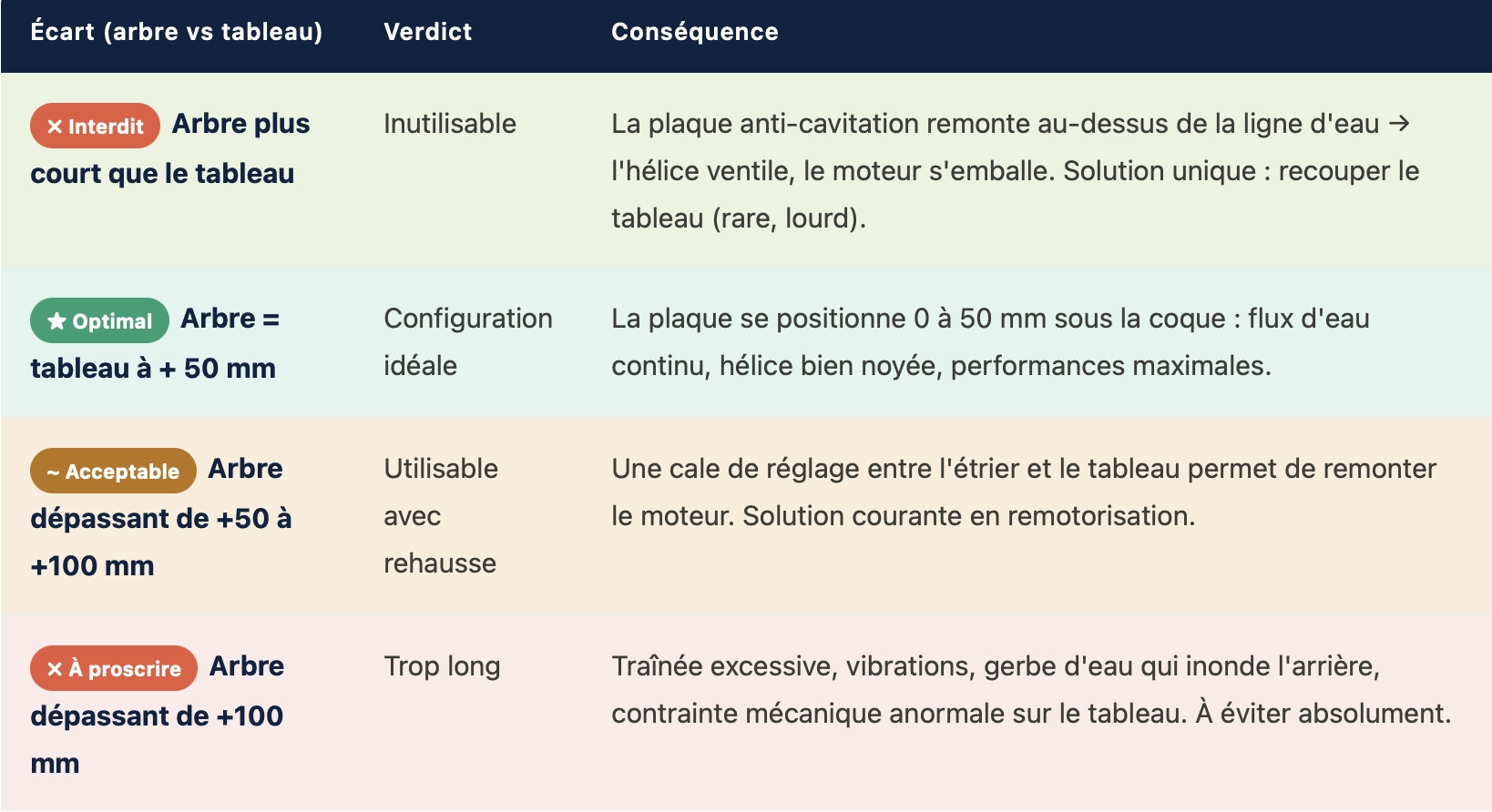
%20a%CC%80%20l%27arbre%20trop%20long%20(trai%CC%82ne%CC%81e).webp)
Practical Selection Rule
📏 Golden rule: it's better to be too long than too short. Raising with shims is simple and inexpensive. Conversely, a shaft that is too short requires modifying the transom or returning the engine — which is cumbersome, time-consuming, and expensive.
If your measurement falls exactly on the border between two classes (for example, a 510 mm transom), select the higher class : an L 508 mm shaft, or even an X 635 mm with a shim, depending on the hull configuration.
Consequences of a Poor Match
Choosing the wrong shaft length doesn't just cause inconvenience: it can seriously damage your engine, your transom, and significantly reduce your range — especially critical for an electric motor.

⚡ Application to the KRONOS Range
The KRONOS is a 100% electric outboard motor designed to replace internal combustion engines on a wide range of boats. It adheres to standard manufacturer norms, ensuring direct compatibility with existing transoms — without cutting or extensive modifications.
Selection procedure for our 100% electric KRONOS motor:
1 Measure the transom height
Boat's central axis, from the bottom of the hull (V-point) to the top of the transom. In millimeters.
2 Identify the nominal class
Compare the measurement to the standard S / L / X / U / E grid to determine the base class.
3 Check available clearance
Allow for 20 to 50 mm of drop below the hull bottom for the anti-cavitation plate.
4 In case of a class boundary
Select the higher class and plan for a shim during installation.
5 For repowering
Also measure the shaft of the existing motor (bracket → anti-cavitation plate distance) for confirmation.
⚡Electric Range at Stake
On an internal combustion engine, raising the shaft by 1 to 3 cm gains a few km/h. On an electric motor like the KRONOS, this directly translates into range: drag costs watt-hours. On a well-designed planing hull, optimized anti-cavitation plate positioning can restore 2 to 5% of range. Beyond that, you enter the cavitation zone and efficiency plummets.
Special Cases
High-Performance Planing Boats
On hulls that plane easily (sport, runabout, bass boat, offshore), the propeller only needs to be barely submerged when planing. Raising the engine reduces drag from the lower unit and shaft, resulting in increased top speed and range. This is the role of a jack plate (hydraulic lift plate): you keep a standard shaft, but shift it upwards.
Shallow Water Navigation
Marshes, deltas, shallow lake fishing. A short shaft allows passage in shallow water, quick lifting without touching the bottom, and extended tilt mode operation. This market, more common in the United States, also exists in the Camargue and some French inland lakes.
Dinghies, tenders, small inflatables
The transoms of these vessels are designed low by construction. The short (S) shaft is simply the nominal match — not an exception.
Surface Propellers
An architecture where the propeller rotates half in the air, half in the water: used for racing, military, or large fast units. The shaft is deliberately shorter than the transom. A niche market, but worth knowing about.
Our team is available to analyze your boat and recommend the optimal configuration.
Published on 05/13/2026
Author: Sophie Castelain

