
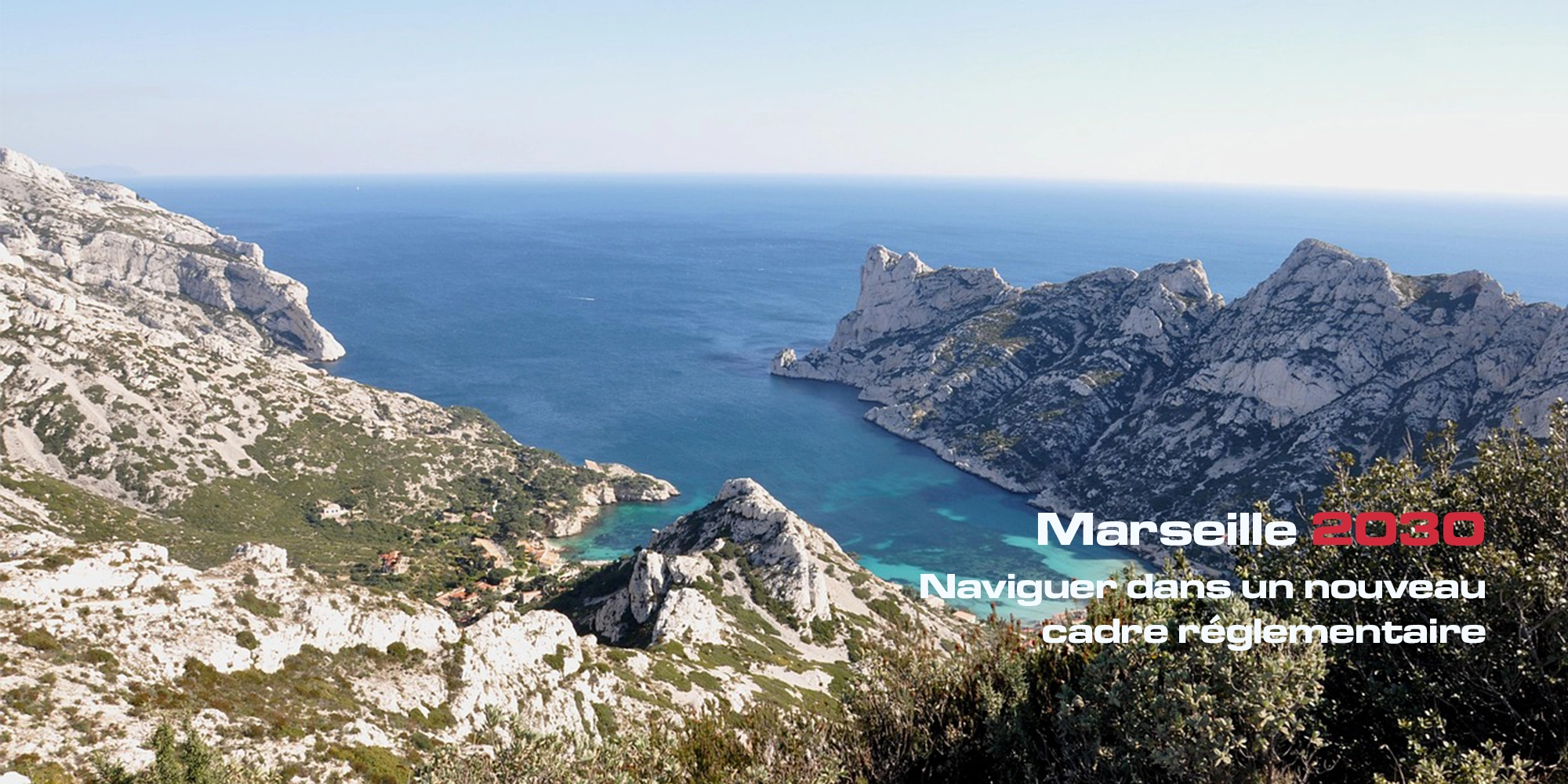
Marseille 2030: anticipate the transformation of the maritime sector
New rules, protected areas, energy transition : what every professional in the maritime sector must anticipate
The French maritime sector is entering a period of profound transformation. Between maritime regulationsreinforced, environmental imperatives and growing societal expectations, marine professionals are facing an accelerating changing environment. TO marseilles, port city par excellence and guardian of Calanques National Park, this transformation is already an operational reality. For players in the sector, understanding this new framework is no longer an option: it is a strategic necessity.
A national target set for 2030
The French maritime sector is evolving in a rapidly changing regulatory framework. The “Roadmap 2025-2030”, co-constructed by the State and actors in the sector, sets a clear course: to accelerate the transition ecological ships and ports, modernise skills and adapt infrastructures. At the international level, the Marpol Convention and the IMO Net-Zero system aim at carbon neutrality ofthe maritime transport by 2050, with the first steps as early as 2025 and 2030.
It is in this national and international context that marseilles stands out as the territory where these transformations take their most concrete and most advanced form.
Marseille and the Calanques: a life-size laboratory
If the national framework sets out the main guidelines, it is marseilles that the transformations take their full measure. The Calanques National Park is the only European park that is both terrestrial, marine and peri-urban, a particularity that makes it the most advanced testing ground in the country. Les regulations which are deployed there prefigure what maritime management will be like in France in the years to come.
Posidonia, a central regulatory issue
Posidonia seagrass beds make up theecological issue structuring the entire local maritime policy. These remarkable ecosystems, the true underwater lungs of the Mediterranean, have lost 20% of their surface area over the last century. In response, random shoreline anchoring has gradually been eradicated in favor of Anchorages and Light Equipment Areas (ZMEL) and ecological buoys. All of the markings on the Marseille coastline are now equipped with anchoring systems that respect the seabed.
Bans by zone complete the system: in the En-Vau and Port-Pin sectors, anchoring, stopping and drifting are strictly prohibited on a permanent basis. All vessels over 24 meters are prohibited from accessing anchor throughout the Park beyond a specific regulatory line.
Zero emission zones before their time
In the most sensitive natural areas of the Calanques National Park, regulations are clearly evolving in favor of clean modes of navigation. Beyond the question of anchoring, it is now thermal engines that are excluded from several emblematic creeks such as Marseilleveyre, Sugiton, Figuerolle or even Anse de la Maronaise.
In these areas, access remains possible only for soft-propelled boats, such as rowing, sailing... or electric motorized boats, whose silent and emissions-free operation makes it possible to preserve fragile ecosystems. Conversely, thermal engines are strictly forbidden there, even when stopped or raised.
These measures foreshadow true zero emission zones at sea, comparable to Low Emission Zones (LEZs) in urban areas, where only environmentally friendly modes of travel are allowed. The fight against noise pollution goes in the same direction: the ban on all musical broadcasting in sites such as Port-Pin, En-Vau, Port-Miou or Anse de l'Arène underlines the growing interest in quiet navigation solutions, a major advantage of electric motors.
What is changing for professionals and users
This regulatory transformation is not only restrictive, it also creates new operational requirements that industry players need to integrate now.
Professionals facing a more demanding environment
TO marseilles, the supervision of commercial activities has tightened. Any vessel authorized for professional rental must now have a green sticker, and the passenger transport requires a specific orange sticker. Rental between individuals is limited to 5 times a year per ship in the heart of Calanques National Park, with the obligation of prior online declaration. Failure to comply with these rules may result in a fine of up to 75,000 euros and two years in prison.
At the same time, the maritime regulations opens up perspectives: administrative simplification through the unique status of the ship will make it easier to switch from private to professional use during the same season. Bridges between skipper certificates and instructor diplomas also facilitate the versatility of teams, thus responding to the recruitment difficulties in the sector.
New technical standards on board
Since 2025, on-board safety requirements have been strengthened. The new Rule 240 introduces several practical requirements for motor ships.
- The circuit breaker must be worn at all times as soon as the engine is running. If the pilot falls into the water, the engine stops automatically.
- A second circuit breaker must be present on board to allow the engine to be restarted from the water in the event of a fall.
- The compass must be waterproof, attached to the boat and visible from the helm.
- The VHF must remain on at all times on the distress channel.
- Life jackets must be adapted to the sailing distance practiced.
For the second-hand market, a pre-sale diagnosis is being deployed. Carried out by a certified professional, it guarantees the buyer that the ship is in good condition and complies with current standards, and allows the seller to value his boat.
Towards decarbonized navigation: the technical solutions available
Faced with the multiplication of areas prohibited to heat engines and with increasing regulatory obligations, the question is no longer whether the transition to alternative propulsion is necessary, but how to operate it effectively and on what timeframe.
Electricity, an immediate response to new constraints
La electric propulsion is the most directly applicable solution to new regulatory and environmental requirements. It offers a concrete response to several simultaneous challenges: zero emissionslocal, quiet operation, and immediate compliance with engine restriction zones.
On a technical level, the electric motors have objective advantages: an energy efficiency of between 90 and 97% against 20 to 30% for a heat engine, around 100 times fewer moving parts drastically reducing wear and tear, and initial maintenance delayed to 5,000 hours of navigation. Economically, consumption that is up to 80% cheaper than fossil fuel, combined with considerably reduced maintenance costs, gives electric propulsion real profitability in the medium term.
For service vessels, the port shuttles, the boats of passenger transport or boats intended for the exploration of protected areas, The electric also offers a differentiating commercial advantage: access to spaces that are now closed to conventional engines.
Good to know
Several areas of the Calanques of marseilles prohibit access to any motorized vessel, even if the engine is off. Only boats propelled by row or sail can access it. For the electric ships using compliant modes of travel, future regulatory changes could open up new opportunities in these sensitive areas.
Weenav: French solutions for navigating in accordance
It is in this context that Weenav develops and deploys its solutions for electric propulsion high power, 100% French, designed to meet the requirements of professionals in the maritime sector.
Whether to equip shuttles, water taxis operating in increasingly regulated areas, service boats or boats dedicated to passenger transport to protected natural areas, the electric motors Weenav offer a direct response to new regulatory constraints: zero emissions local, absolute silence, proven performance and reliability.
The Weenav range extends from KRONOS outboard motor At ARION inboard system, and offers solutions for Retrofit allowing existing boats to be electrified without complete replacement. This modular approach allows professionals to plan their energy transition gradually, by controlling investments while complying with regulatory deadlines.
In an environment where thermal propulsion areas are shrinking and regulatory pressure is increasing, have a electric fleet is no longer just an environmental argument, it is a sustainable competitive advantage.
The maritime transition is under way. TO marseilles as on the entire French coastline, professionals who anticipate this shift today will be the best positioned to operate in the context of tomorrow. Weenav is the ideal partner to achieve this.
Posted on 13/02/2026
Editor: Chloé QUITTOUD

