

Three engineers, one shared conviction: boating can reinvent itself through electric propulsion. Here is the story of Weenav, its values, and its activities.
Who are we at Weenav?
We are three engineers specializing in smart electric vehicles, driven by a shared conviction: the maritime sector, still characterized by noisy, polluting, and energy-intensive engines, needed a cutting-edge alternative.
It was in late 2021 that we decided to put our expertise at the service of a sector still largely on the fringes of decarbonization discussions, even though boating alone accounts for 3% of global emissions. Our objective: to green existing fleets and offer a credible alternative to thermal engines, one that is quieter, cleaner, and just as powerful.
Anthony Tartare, founder and CEO, oversees the company's administrative and technical aspects. Kevin Capendu, founder and sales manager, supports our clients in their transition to clean propulsion, leveraging his dual technical and commercial expertise. Antoine Bouchez, founder and Chief Operating Officer, also oversees the company’s technical activities.
How was our first electric motor born?
This project gave birth to Weenav in April 2022, a name that can be read as "we navigate electrically." Like many great entrepreneurial stories, ours began in a garage in Hauts-de-France.
On December 27, 2022, we conducted our first real-world tests in the English Channel. Our test boat, a 1992 FourWinns 195 Sundowner initially equipped with a 175-horsepower thermal engine, was fully converted to 100% electric propulsion, with a 100-horsepower (73 kW) motor and 54 kWh of batteries. It then sailed throughout the summer season in the Mediterranean, validating our full-scale approach.
The year 2023 marked a turning point: participation in CES Las Vegas, fundraising, and presence at several professional trade shows. These milestones allowed us to position ourselves as pioneers in Europe for high-power 100% electric propulsion for boats. In 2025, we launched our two flagship ranges: the KRONOS outboard motor and the ARION inboard motor. In 2026, we are taking a new step by moving into larger premises, designed to support the industrialization of our engines and our ramp-up.
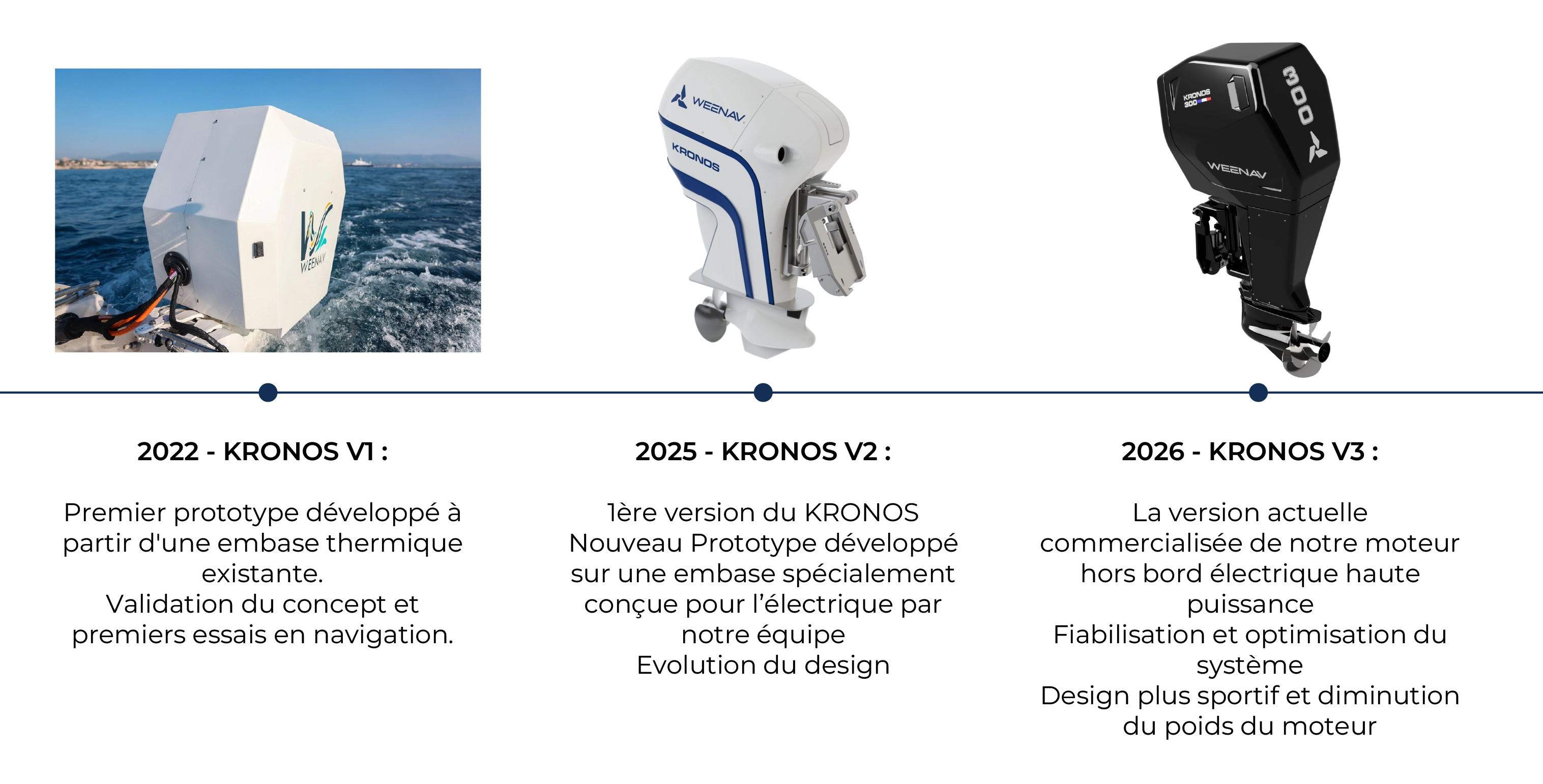
What are the key stages in the development of our KRONOS engine?
What exactly do we offer today?
Since then, our catalog has been structured around these two ranges of electric motors compatible with series hybrid: the KRONOS, our outboard designed for the fastest and most demanding uses, and the ARION, our inboard motor, robust and discreet, which installs directly into the boat's bilge. These two ranges cater to all types of projects, whether it's equipping a new boat or giving new life to an existing vessel through electric repowering.
Repowering holds a special place in our business, because a boat has an average lifespan of 40 years. Repowering is part of its natural cycle, and allows for the retention of an existing hull and fittings while significantly reducing greenhouse gas emissions compared to building a new boat. It's a tangible way to make the energy transition in boating accessible without waiting for a complete fleet renewal.
Regardless of the project, we systematically guide our clients towards the most suitable existing financing solutions and subsidies for their situation, so that the switch to electric or hybrid remains an accessible choice. And to truly understand the impact of high-power electric propulsion, nothing beats a real-world test drive: our test sessions KRONOS 250 have just resumed on Lake Geneva.
What values drive us?
Three values guide every decision we make, from technical development to customer relations.
- Eco-innovation, because we believe that technology should serve the planet, not the other way around. Every engineering decision for our electric and hybrid engines aims to balance performance with environmental protection.
- Technical excellence, because we refuse to sacrifice power for clean propulsion. Our engines are designed to meet the demands of the most discerning boaters, whether for recreational use, fishing, or professional applications.
- Shared responsibility, because we believe that the transition in boating will not happen without collective awareness. We encourage our community to adopt more responsible boating practices, beyond just the choice of engine.
What are our CSR commitments?
Beyond the product, we are committed to reducing thecarbon footprint of boating and preserving the marine and river ecosystems. Our electric and hybrid engines emit no hydrocarbon leaks, generate no toxic waste, and significantly reduce noise pollution for aquatic wildlife, unlike traditional combustion engines.
This commitment to preservation extends to the very design of our engines: their lifespan is at least 3 times longer than that of an equivalent combustion engine, and their maintenance cost is almost zero. An engine designed for longevity is also a way to limit the constant replacement of equipment and reduce the pressure on the resources needed for their manufacture. For us, truly responsible navigation is built on durability, not just at the moment of choosing the engine.
Published on 25/06/2026
Author: Chloé Quittoud

